
DANGOTE & EAST AFRICA: THE PARTNERSHIP POWERING AFRICA’S NEXT GROWTH STORY
Addis Ababa, October 3, 2026 (ABN Insite)
A new chapter is emerging in Africa’s industrial transformation as Dangote Group expands its investment ambitions across East Africa, connecting major projects in energy, manufacturing, fertiliser, infrastructure and regional trade. From Ethiopia’s agricultural-industrial ambitions to Kenya’s planned mega-refinery and Tanzania’s expanding investment pipeline, the Dangote footprint is increasingly becoming part of a wider conversation about African capital, regional integration and industrial growth.
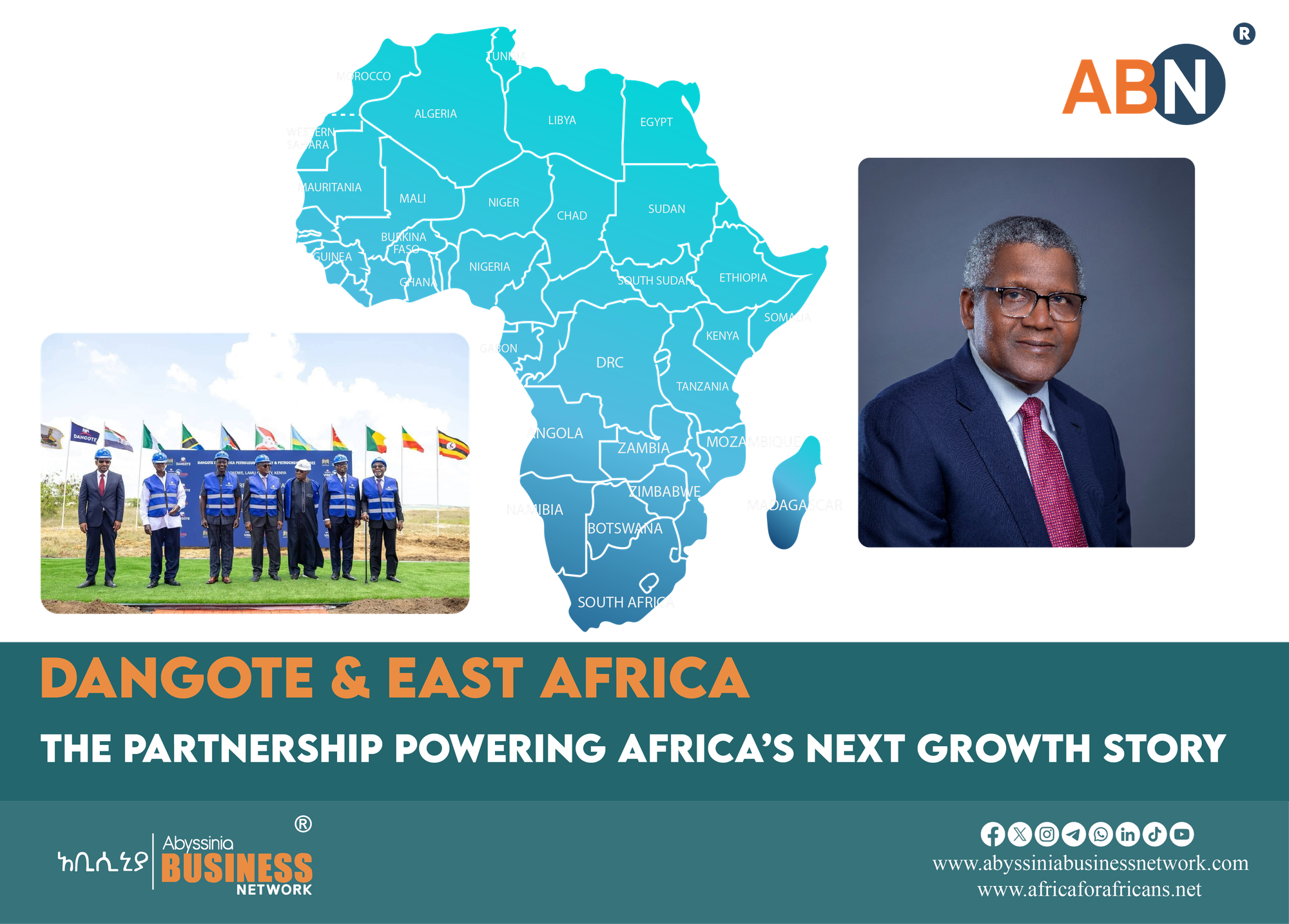
The latest development is the groundbreaking of the Dangote East Africa Refinery in Lamu, Kenya, a proposed $16 billion project designed around a capacity of 700,000 barrels of crude oil per day. The project is planned to include a 1,000-megawatt power plant as well as fertiliser and chemical manufacturing facilities. Construction began on September 30, 2026, with Kenyan President William Ruto and Dangote Group President and CEO Aliko Dangote participating in the groundbreaking ceremony.
The scale of the Kenyan project gives the East African market a new industrial dimension. Dangote has said the refinery is intended to serve a broad regional market stretching from Ethiopia to Mozambique, potentially reducing dependence on imported refined petroleum products and strengthening regional energy security. The project is scheduled for completion in 2030 and has been described by Kenyan authorities as a major investment in industrialisation and the LAPSSET Corridor.
For East Africa, the significance extends beyond petroleum. A large refinery can create demand for logistics, storage, transportation, engineering, manufacturing, financial services, construction and skilled labour. The planned power generation and chemical industries could further expand the industrial ecosystem around the project, creating opportunities for companies and investors across the region.
Ethiopia is emerging as another major part of Dangote’s East African strategy. Dangote Group and Ethiopian Investment Holdings have agreed to develop a $2.5 billion urea fertiliser complex in Ethiopia’s Somali Region. The project is designed to produce up to three million tonnes of urea annually, with Dangote holding a 60 percent stake and Ethiopian Investment Holdings 40 percent, according to reporting by The EastAfrican. Construction began in October 2025.
The Ethiopia connection is especially significant because it links industrial investment with agriculture. A large-scale fertiliser facility could strengthen domestic production capacity, reduce dependence on imported fertiliser and support agricultural productivity while establishing an industrial base in eastern Ethiopia. It also places Ethiopia within a broader regional industrial network connecting production, logistics and consumer markets.
The partnership between Dangote and Ethiopia is also moving into energy infrastructure. In September 2026, Dangote and Ethiopian Investment Holdings announced plans for a $660 million petroleum-products pipeline connecting Ethiopia with Djibouti’s coast. The proposed 120-kilometre pipeline is expected to include petroleum storage facilities at Damerjog and Dewele, creating additional infrastructure for the movement and storage of fuel.
This combination of fertiliser production and petroleum infrastructure gives Ethiopia a distinctive position in the emerging regional network. The country provides a large consumer and agricultural market, while its connection to Djibouti provides access to a major maritime gateway. Together, these projects demonstrate how industrial investment can increasingly move across borders and connect inland markets with ports and international supply chains.
Tanzania represents another important pillar of the expanding relationship. Dangote Group has held discussions with the Tanzanian government on potential investments spanning transport infrastructure, fertiliser production, power generation, ports and regional trade. The discussions signal an effort to expand beyond cement into a broader industrial portfolio.
Dangote already has an established cement operation in Tanzania. Its Mtwara plant has annual production capacity of approximately three million tonnes, while the company maintains a broader presence across several African markets. Dangote Cement says it operates in 11 African countries, with total African production capacity of up to 55 million tonnes annually as of 2025.
The regional picture therefore extends beyond a single company’s expansion. It reflects a wider shift in the African business environment: African companies with significant capital and industrial experience are increasingly looking across borders for opportunities to build production capacity closer to African consumers.
The Dangote East Africa Refinery could become a major test of this model. Kenya’s coastal location, the LAPSSET corridor and links to neighbouring economies provide the potential for the refinery to become part of a broader regional supply chain. At the same time, the project faces practical challenges, including crude-oil supply, infrastructure requirements, financing, environmental concerns and competition from other regional petroleum projects.
For Ethiopia, Kenya, Tanzania and neighbouring economies, the emerging Dangote network raises a larger strategic question: how can major African investments generate value across borders rather than operating as isolated national projects?
The answer increasingly lies in regional connectivity. A refinery requires transportation networks and storage. Fertiliser production requires energy, logistics and agricultural markets. Manufacturing requires reliable power, roads, ports and finance. Ports require efficient inland corridors. Each investment can therefore create demand for another layer of infrastructure and services.
This is where East Africa’s economic geography becomes particularly important. Ethiopia offers a large inland market and agricultural potential. Kenya provides access to the Indian Ocean and the Lamu corridor. Tanzania offers strategic ports and established industrial capacity. Djibouti remains a critical maritime gateway for the Horn of Africa. Connecting these assets through investment, infrastructure and trade could create opportunities well beyond the individual projects.
Dangote’s expansion also carries a broader African business message. Much of Africa’s industrial development has historically depended heavily on foreign capital and imported industrial products. The growth of large African-owned industrial groups creates another model in which capital generated on the continent can be deployed across multiple African markets.
The company’s experience in cement provides an example of this approach. Dangote Cement has operations across West, Central, East and Southern Africa, including Ethiopia, Tanzania, Zambia and South Africa, demonstrating the potential for African industrial companies to develop regional production networks.
The next phase is more ambitious: energy, fertiliser, infrastructure and manufacturing working together as an integrated regional growth platform.
For East Africa, the opportunity will depend on how effectively governments, investors and businesses coordinate infrastructure, trade policies, financing and skills development. Large investments can provide industrial capacity, while regional cooperation can determine how widely the resulting economic benefits are distributed.
Dangote’s growing East African footprint therefore represents more than an expansion of one African business empire. It is becoming a case study in how African capital, regional markets and cross-border infrastructure could combine to support the continent’s next phase of industrialisation.
From Lamu to Addis Ababa, from Mtwara to Djibouti, a new economic map is taking shape—one where African investment increasingly crosses national borders and where energy, agriculture, manufacturing, logistics and infrastructure are becoming interconnected.
The emerging Dangote-East Africa story could ultimately be measured by more than the value of individual projects. Its broader significance will depend on how successfully these investments create productive capacity, strengthen regional supply chains, expand employment and deepen trade across African markets.